Atechly Repair Hub: Expert Solutions for Your Tech
Got a faulty device? Don’t replace it—repair it! At Atechly, we specialize in high-quality repairs for networking and security hardware. Our expert technicians ensure your devices are back to “like-new” condition quickly and affordably.
Atechly Repair Hub: Expert Solutions for Your Tech
Got a faulty device? Don’t replace it—repair it! At Atechly, we specialize in high-quality repairs for networking and security hardware. Our expert technicians ensure your devices are back to “like-new” condition quickly and affordably.
In an era where high-speed data is non-negotiable, wireless networking has evolved from a “backup option” to a primary infrastructure solution. For ISPs, industrial plants, and security firms in India, digging trenches for fiber optic cables is often too slow and prohibitively expensive. This is where long-distance wireless devices come into play.
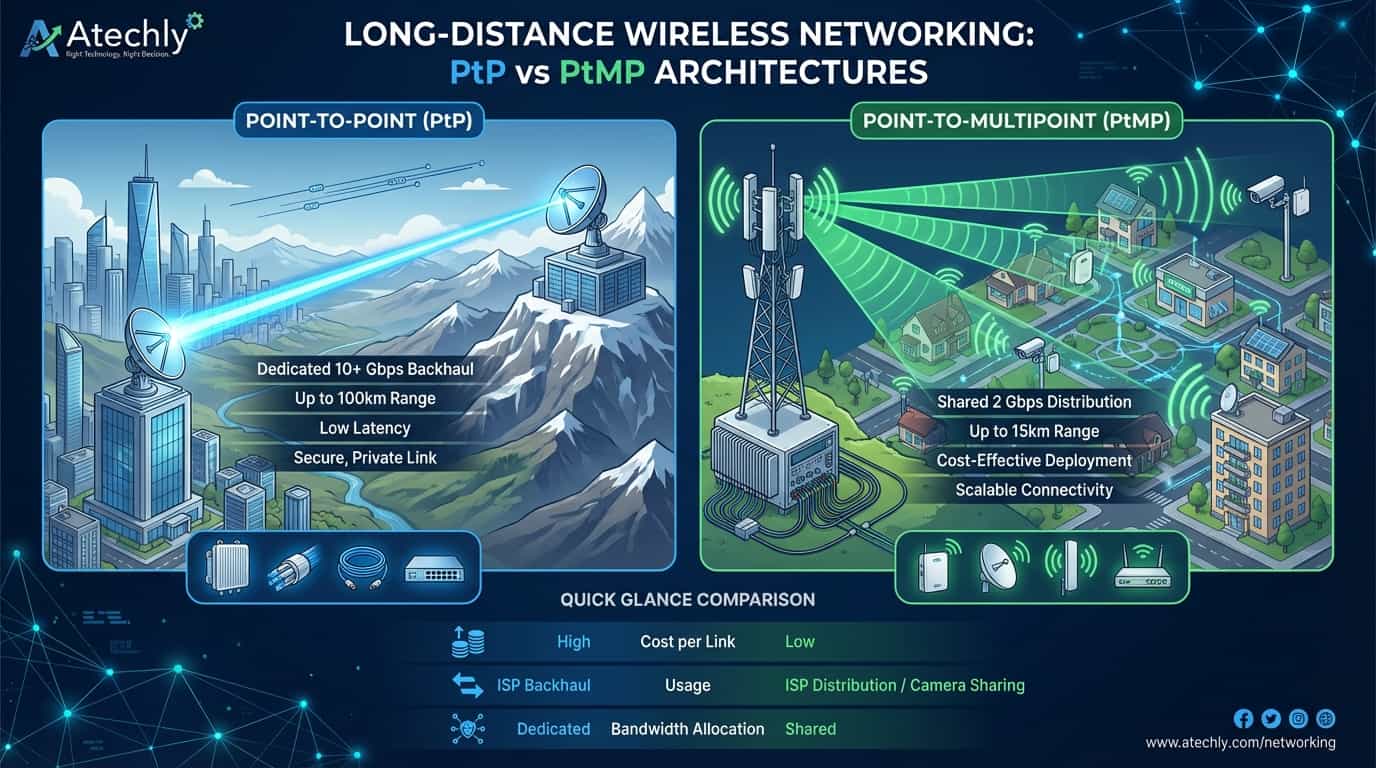
Point-to-Point (PtP) functions as a dedicated “Wireless Bridge.” It involves two high-gain radios aligned perfectly to create a private data tunnel. Think of it as a virtual fiber cable stretched through the air. In 2026, PtP links are achieving speeds exceeding 10 Gbps over distances of 20km to 50km, making them ideal for ISP backhaul and connecting remote office branches.
Point-to-Multipoint (PtMP) works on a “Base Station” model. One central sector antenna (the Access Point) broadcasts a signal to multiple “Subscriber Modules” (CPEs) within a specific arc (usually 30°, 60°, or 90°). This is the standard for localized ISP distribution (WISP) and large-scale CCTV deployments, such as monitoring an entire city square or an industrial campus from a single command center.
Main Purpose & Application Areas
ISP Bandwidth Distribution: Small and medium ISPs use PtMP to provide “Last Mile” connectivity to residential buildings without physical wiring.
Long-Distance 4K/8K Camera Sharing: Security agencies use PtP links to transmit high-resolution video feeds from highway toll booths or forest borders back to a central NVR.
Campus Network Sharing: Universities and hospitals use these devices to share local servers, ERP systems, and internet across multiple buildings.
Disaster Recovery: Rapidly deploying internet to areas where physical infrastructure has been damaged.
Types & Versions
Wireless Device Type
Description & Features
Best Usage / Distance
Integrated Antennas
Radio and antenna are housed in a single, compact unit. Simplifies installation and reduces cable loss.
Short to Medium range (2km – 10km). Ideal for quick deployments.
Connectorized Radios
The radio unit is separate, allowing users to attach high-gain external dish antennas via RF cables.
Extreme Long-range (30km+). Perfect for ISP backhaul across rough terrain.
Millimeter Wave (mmWave)
Operates at the 60GHz frequency. Delivers fiber-like speeds with multi-gigabit throughput.
Short range (Under 2km). Requires strict Line of Sight (LoS). High-density urban links.
Comprehensive Comparison
Feature
PtP (Point-to-Point)
PtMP (Point-to-Multipoint)
Typical Capacity
1 Gbps to 10+ Gbps
500 Mbps to 2 Gbps (Shared)
Max Distance
Up to 100km+ (with dish)
Up to 10km-15km
Setup Complexity
High (Precise Alignment)
Medium (Sector Alignment)
Interference Risk
Low (Highly Directional)
Moderate (Broad coverage)
Primary Goal
High-capacity Backhaul
Multi-user Distribution
The Indian Market: Brands & Pricing
Most Used Brands:
Ubiquiti (AirFiber, LTU, PowerBeam): The gold standard for WISPs in India due to the intuitive interface.
MikroTik (NetMetal, BaseBox): The go-to for advanced networking professionals who need deep routing control.
Cambium Networks (ePMP, PTP series): Preferred for high-density enterprise and government projects.
Mimosa (C-Series, B-Series): Gaining traction for high-performance urban links.
AI-Spectrum Sensing: Radios now use machine learning to predict interference patterns and switch frequencies before the connection drops.
Sustainable Energy: Newer outdoor radios are being designed with ultra-low power consumption to run entirely on small solar panels for remote forest/farm monitoring.
Wi-Fi 8 Implementation: Early prototypes of Wi-Fi 8 long-range devices are focusing on “Reliability over Speed,” ensuring stable pings for gaming and VOIP over wireless links.
Atechly is an innovative IT marketplace and solutions company dedicated to bridging the gap between industry creators and service providers. You empower businesses, professionals, and students with modern digital tools, training, and growth opportunities in the rapidly evolving technology landscape.